

Matteo Ragazzi
Italy
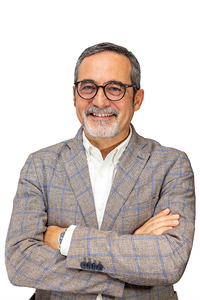
From Leadership Profile: Vertiflite, November/December 2026
Matteo Ragazzi
Matteo Ragazzi likes the perspective that comes with being a small figure in a larger providence. Hiking in the Alps, away from the demands of leading engineering at Leonardo Helicopters, he finds room to reconsider what otherwise fills his day. That willingness to step outside the familiar runs through his life.
Growing up moving between Italian cities, Ragazzi began his career abroad and pursued engineering with an instinct to explore across disciplines. It helped make him an exceptional aircraft engineer and a champion of the AW139, whose development and maturation he guided through its first million flight hours. Today, as senior vice president of engineering and innovation, he brings that same breadth to Leonardo’s wider helicopter portfolio.
Ragazzi tells the story with little self-importance. His recollections return to the people who gave him opportunities, the teams that delivered and the enjoyment of solving difficult problems together.
Learning to see the whole aircraft
Born in Milan, Ragazzi moved to Genoa as an infant, spent approximately nine and a half years in Naples, then returned to Genoa and eventually Milan. In communities where families often remained rooted for generations, he was frequently the newcomer. Asked where he comes from, he finds it simplest to say he is Italian.
He loved drawing and began sketching airplanes while young. Flight fascinated him, although he struggled to imagine a place for himself in aviation. Learning at 15 that he needed glasses seemed to narrow the prospect of becoming a pilot. Engineering emerged as a possibility later, accompanied by doubts about whether his habit of lateral thinking suited the profession.
Experience would show how valuable that habit could be. Even as a student, he wanted to understand the aircraft as a whole, learning the languages of structures, aerodynamics, propulsion and avionics well enough to bring them together. “I was obsessed not to specialize,” he recalled.
At the Politecnico di Milano, he acquired a strong theoretical foundation. He also recognized the distance between solving an academic problem and making a real aircraft work. Practical experience would supply an essential part of his education. His first job took him to Pilatus in central Switzerland, where he worked in aerodynamics and contributed to the PC-12’s initial certifi cation. The international engineering and flight test environment widened his outlook further. He also learned enough German to manage everyday life in a region far removed from Italian-speaking Switzerland.
Finding opportunity at Agusta
Ragazzi returned to Italy seeking the stability to marry and build a life. He joined Agusta in 1995 during a period of rebuilding, when younger engineers received substantial responsibility and opportunities to grow.
He began in transmission design, working on the drive system of the helicopter now known as the AW119. He subsequently became its project engineer and chief project engineer, gaining the aircraft-wide responsibility he had hoped to pursue. The transition mattered. A transmission specialist must understand a demanding technical discipline; a chief project engineer must also reconcile the decisions of many disciplines with the needs of the complete aircraft. Ragazzi’s curiosity about how those pieces fit together had found a practical purpose. He had not planned to spend three decades with the company. New challenges kept arriving, and he kept finding the work rewarding. “I was living a full portfolio of opportunities,” he said.
Championing the AW139
The AW139 became the defining challenge of Ragazzi’s career. He is careful to distinguish his contribution from the helicopter’s initial certification. He took responsibility for advancing the design into a mature product, resolving problems, developing capabilities and supporting its growing operational life. The task initially seemed beyond reach. Drawing on his AW119 experience, he examined the plans and questioned whether the required pace was possible. The team nevertheless found ways to deliver. By his recollection, drawings, certification work and changes eventually moved about four times faster than on the earlier program. “We shaped the company around this product,” he said.
That achievement extended beyond engineering output. Ragazzi credits Bruno Spagnolini with insisting that engineers meet customers directly. Engineering would have to hear operators’ expectations firsthand and answer for the solutions it promised. For Ragazzi, those meetings could be demanding, but they changed his understanding of the job. An engineer facing a customer must listen closely, recognize the operational problem and translate it into something the aircraft can deliver. The personal commitment also becomes unmistakable: the customer remembers who said a capability would be provided.
This was especially important as the company sought a stronger position in offshore operations. Customers including Shell wanted more power, performance and safety. Ragazzi recalls that their willingness to support the AW139 helped establish the value of its overall balance, even when it required buying a larger helicopter than the aircraft it replaced.
Over roughly a decade, his responsibilities included anti-icing development and supporting the fleet to its first million flight hours. His engineering leadership helped turn the AW139 into a product around which the company could grow.
Despite the scale of his contribution, he speaks about the team’s success with characteristic restraint. He wonders whether they had simply found a fortunate recipe, perhaps a “dream team.” The modest telling leaves the accomplishment clear: he served in the linchpin roll to carry a promising aircraft through the sustained engineering work that made it successful in service.
Applying experience across the company
After the million-hour milestone, Ragazzi asked for another challenge. As chief project engineer of the AW189, he applied his experience to entry into service and anti-icing work.
Ragazzi then became head of airworthiness within the company’s European Union Aviation Safety Agency (EASA) design organization approval. The assignment expanded his infl uence from individual aircraft to the practices supporting development and certifi cation across the organization.
His approach remained practical. Lessons acquired on real programs needed to become methods that other teams could use. Engagement with EASA offered an opportunity to contribute to aviation safety more broadly, and he found that meaningful participation began with joining the discussion and doing the work.
In 2019, Leonardo Helicopters promoted Ragazzi to director of engineering, and in 2022 gave hime additional technology and innovation responsibilities. By this October 2026 interview, he described an engineering community of approximately 2,400 people spanning several countries.
Leading that community requires the same ability to connect perspectives that first drew him toward the whole aircraft. He sees diversity as an asset, particularly when teams share a strong attachment to the product. Engineers need opportunities to encounter the aircraft itself, to visit the hangar and see the results of their decisions.
A common purpose gives diff erent backgrounds something to work toward together. It also helps prevent a team from mistaking its own familiar assumptions for the only way to understand a problem.
Keeping perspective
Ragazzi’s interest in the next generation refl ects his own early experience. He described Leonardo’s drone competition, involving six universities over four years, as a way to help students gain practical experience alongside their theoretical preparation. Th e satisfaction of making something work remains central to his view of engineering.
Away from work, he enjoys cycling and fi shing as well as hiking. A summer journey took him through the Alps, Austria and Slovenia before returning to northeastern Italy. Exploring still gives him pleasure, much as new technical responsibilities have throughout his career.
The mountains also restore a useful sense of proportion. Daily pressures can make an established approach feel inevitable; distance creates room to question it. Th at connection between refl ection and practical judgment helps explain Ragazzi’s contribution to aircraft development and airworthiness. He can consider the larger problem, listen to diff erent perspectives and then return to the detail required to move an aircraft forward.
The engineer who once wondered whether lateral thinking belonged in aviation has spent his career demonstrating its value. On a mountain trail, as in the development of a helicopter, Ragazzi remains willing to look beyond the route immediately in front of him.